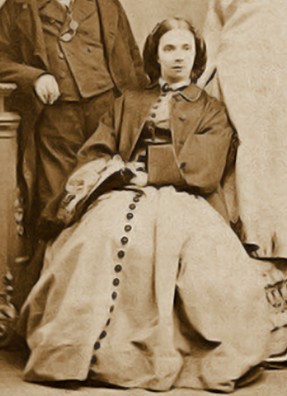
 Frances "Fanny" Mary Blackett (1822 – March 14, 1895)—later best known as Madame du Quaire—was an English salonnière, socialite, and prominent expatriate figure within
19th-century Anglo-French literary and artistic circles.
Frances "Fanny" Mary Blackett (1822 – March 14, 1895)—later best known as Madame du Quaire—was an English salonnière, socialite, and prominent expatriate figure within
19th-century Anglo-French literary and artistic circles.Queer Places:
10 Grosvenor Sq, London W1K 6JP, UK
Saint Mary the Virgin Churchyard, Ovingham, Prudhoe NE42 6BW, United Kingdom
Frances "Fanny" Mary Blackett (1822 – March 14, 1895)—later best known as Madame du Quaire—was an English salonnière, socialite, and prominent expatriate figure within
19th-century Anglo-French literary and artistic circles.
Born into an influential, landed Northumbrian family, she was the daughter of Christopher Blackett and Elizabeth Montagu, and sister to John Fenwick Burgoyne Blackett (MP for Newcastle-upon-Tyne), Lieutenant Edward Algernon Blackett, and Montagu Blackett.
During her early adulthood in the late 1840s and early 1850s, Blackett lived as an unmarried spinster at 10 Grosvenor Square in London. Following the death of her father, her financial and social independence was closely restricted by her elder brother, John, who became the head of the household.
Despite these patriarchal family constraints, Blackett cultivated an energetic involvement in London’s cultural and political life. Her lively, frank correspondence during the 1850s with the political writer and novelist Marie Rose Blaze de Bury documents her attempts to assert personal autonomy. These letters show Blackett quietly arranging independent travel to Paris, maneuvering around family oversight, and attempting to act as a patron to visiting artists, such as the German pianist Ernst Haberbier.
In 1857, Blackett married a Frenchman, Claude Félix Henry du Quaire (Chevalier du Quaire), an ardent Catholic and Legitimist. The union was short-lived, as Du Quaire died in 1860.
As a wealthy, childless widow—Madame du Quaire—Fanny acquired complete personal freedom and social standing. Known for her striking appearance (tall, strong-featured, and red-haired), directness, and cheerful disregard for Victorian social decorum, she established herself in Paris and London as a beloved, formidable hostess and confidante.
Her inner circle included many of the period's most famous literary and artistic figures:
She was a close personal confidante to both Robert Browning and Elizabeth Barrett Browning. In a famous exchange, when Fanny praised Robert Browning's poetry over his wife's, Robert passionately corrected her, insisting that Elizabeth possessed true creative "genius."
Henry James penned an affectionate, elegiac tribute to her in William Wetmore Story and His Friends (1903), remembering her "boundless extent of her acquaintance" and her sharp, amused view of high society.
Matthew Arnold, Alexis de Tocqueville, Dante Gabriel Rossetti, James McNeill Whistler, and Oscar Wilde, all frequented her orbit or counted among her wider acquaintance.
While historical records do not explicitly define Fanny Blackett’s personal romantic orientation, her life and network cross paths with queer history, decadent literature, and 19th-century homosocial dynamics in several key ways:
One of the most direct connections between Blackett and late-Victorian LGBTQ+ history comes from her relationship with Marc-André Raffalovich).
Raffalovich was a prominent French-born poet, writer, and early advocate/theorist for homosexuality (then discussed under terms like "uranism" or "inversion"), as well as the lifelong partner of poet John Gray.
Writing under the pseudonym Alexander Michaelson for New Blackfriars, Raffalovich offered a humorous, perceptive character sketch of Fanny. He famously quipped that one liked to imagine she had "invented marriage, widowhood, and Chevalier du Quaire, so as to be freer than a Victorian spinster," highlighting how she strategically used social institutions to achieve personal liberation outside traditional heteronormative expectations.
Through her friendship with figures like Raffalovich, Oscar Wilde, and members of the Pre-Raphaelite/Aesthetic movements, Madame du Quaire was a active participant in the avant-garde social spaces where 19th-century queer writers, artists, and intellectuals found refuge, patronage, and community.
Blackett’s intimate correspondence with Rose Blaze de Bury places her at the heart of 19th-century female homosocial networks.
During an era when patriarchal law limited unmarried women's legal agency, women like Blackett and Blaze de Bury built robust, international support systems.
They leveraged these private friendships to share advice on navigating male guardianship, achieving financial self-determination, and moving freely through public, artistic, and political spheres.
The Blacketts of Wylam were an influential, landed Northumbrian gentry family. Their estate at Wylam fell within the parish of St. Mary the Virgin in Ovingham, along the River Tyne. Henry James famously noted that Madame du Quaire was "Of old Northumberland race". Her father, Christopher Blackett (1787–1847), was born at nearby Wylam, Northumberland, and served as M.P. for South Northumberland. Her mother, Elizabeth Burgoyne (1792–1833), was born in Ovingham. The Church of St. Mary the Virgin in Ovingham served as the traditional burial ground and parish church for the Blacketts of Wylam. Many members of Fanny’s immediate family—including her elder brother, John Fenwick Burgoyne Blackett, M.P. (1821–1856)—were interred in the family burial plots or vault at Ovingham. While Fanny spent much of her adult life living as an expatriate in Paris or in fashionable London (where she died in 1895 at Belgrave Square), her social identity, property, and family lineage remained tightly bound to her family's ancestral home in Ovingham and Wylam, Northumberland.
References:
Support this project
This website is a passion project researched, developed, and funded entirely by me. If you find the content valuable and would like to help support the ongoing research and hosting costs, any contribution is deeply appreciated.
Thank you for keeping this independent resource alive!
My books on Amazon: Elisa Rolle's books